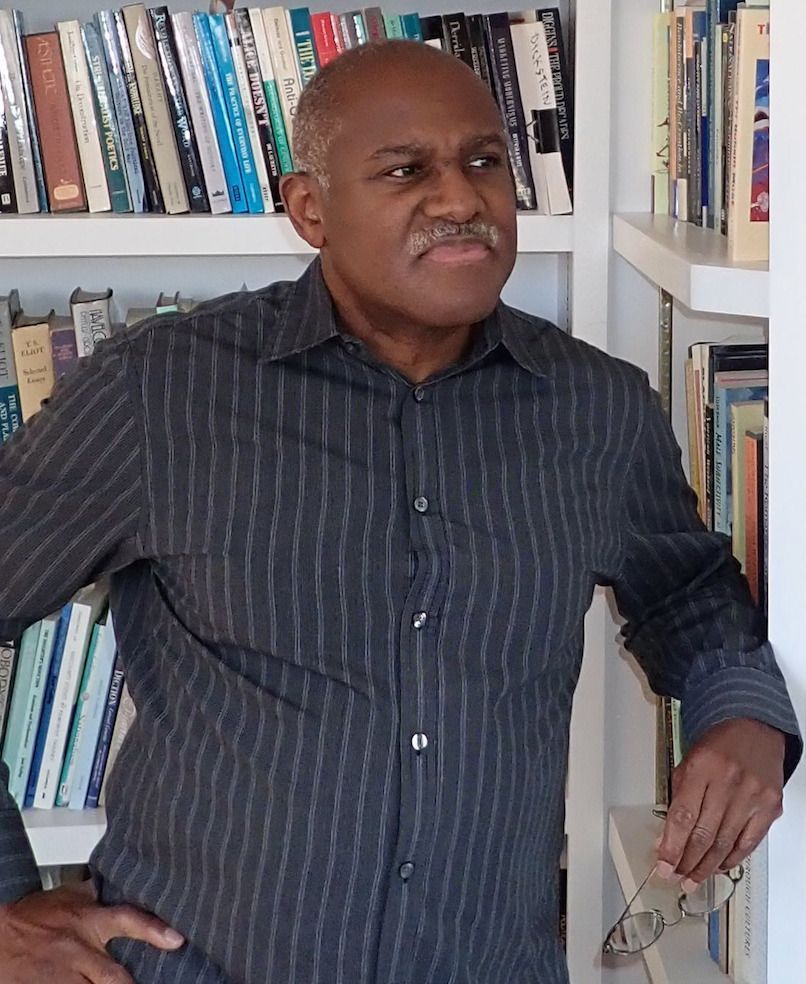
Callaloo Contributor: Marlon Ross

Callaloo . • February 27, 2026

Callaloo Contributor: Marlon Ross

"An Interview with the Editors of Love Is A Dangerous Word: The Selected Poems Of Essex Hemphill" by Marlon B. Ross appears in CallalooIssue 43.4.

What themes or messages do you hope readers take away from this interview?


My interview with the two editors, Robert F. Reid-Pharr and John Keene, of Essex Hemphill's "Love Is a Dangerous Word: Selected Poems" epitomizes Callaloo's ongoing commitment to the recovery of important creative work by artists of the African Diaspora. I want through the interview to emphasize not only the importance of this kind of editorial labor but also the personal, intellectual stake that helps to shape how these two brilliant scholars approach Hemphill and his work. Having passed away from HIV/AIDS at an early age, Hemphill represents a generation of Black queer authors whose impact we cannot afford to forget, and this volume plays a vital role in helping to consolidate the poet's legacy. I was especially interested in the editors' views on Hemphill's influence on his generation as well as his influence on current work, including on the editors, both of whom knew Hemphill personally. Topics of the interview include Hemphill as a poet of queer desire, its inhibitions and impediments, as his poetry vividly captures the brokenheartedness of gay male cruising, as well as the visceral, material joys of queer sex. How does Hemphill address the HIV/AIDS crisis, as an early activist as well as someone deeply aware of his own impending death from the virus. In the interview, the editors confirm the ways in which Hemphill was a "local" poet who gives us a complex, compelling portrait of Washington, D.C. at a time when "Chocolate City" is being maligned by the powers-that-be as the nation's crime capital. Beyond the local, the volume helps us to place Hemphill within the long tradition of African American poetics, and as such brings attention to the poet's craft as an experimenter with form, structure, narrative, and voice. I was especially curious to hear from Reid-Pharr and Keene about their own pedagogy as teachers of Hemphill's work, as the volume will certainly bring greater attention to what Hemphill continues to teach us within our classrooms.


Can you share about how your academic journey led you to Callaloo


I became involved in Callaloo almost by accident when I gave a paper entitled “Callaloo, Everyone?”, delivered at a special session, “Callaloo and 25 Years of Writing in the African Diaspora,” of the Modern Language Association Annual Convention in New Orleans in 2001. I believe that this became my first publication in the journal, when it was printed in “Reading Callaloo/Eating Callaloo” (volume 30.1 [Winter 2007]), the first of four 30th anniversary special Issues, guest-edited by Shona N. Jackson and Karina L. Céspedes. After 2001, I became an Associate Editor of the journal. When Charles Rowell asked me to serve as the section editor for criticism and theory, I took on that role for more than a decade. One simply could not refuse a request from the great editor. I was also heavily involved over this period with the annual Callaloo conferences, and, along with Dagmawi Woubshet, played a key role in organizing the first Oxford conference.


What does being a part of Callaloo mean to you ?


I feel that I gained so much more from my involvement with Callaloo than I have given to it. It became, indeed, a center of my intellectual life. Adjudicating the criticism and theory submissions, helping to organize the conferences and participating in them, occasionally publishing in the journal, particularly papers delivered at the conferences, conversing deeply with Callaloo colleagues, including poets and fiction writers -- all these activities have had an indelible influence on how I think, write, and teach. I was trained as a specialist in British Romanticism, with my publications, research, and teaching in the early part of my career devoted to this field. Of course, I had long read deeply in African American literature, but I made a shift to teaching and publishing in this field after being asked to submit an essay on black masculinity in a volume on that subject. Becoming a member of the Callaloo collective, so to speak, facilitated this field shift, as it shaped, exemplified, and affirmed my ongoing commitment to African American and African Diaspora studies.


How does this interview connect to the larger body of your work?


One cannot browse issues of the journal without gaining a deep sense of the longer tradition and future of work in this field, its import, its reach, and its intellectual and artistic power. It would be a challenge to try to quantify how working on and reading the journal has helped to feed my own work, but that is no doubt the case. The journal is the published proof of a much larger collection of activities and projects. To be in dialogue with these is to be sustained creatively. For example, I had the privilege of being on a panel at the "Love" conference at Princeton in 2012. I delivered a paper entitled “‘What’s Love but a Secondhand Emotion?” Man-on-Man Passion in the Contemporary Black Gay Romance Novel." Sharon Holland was a co-presenter, Koritha Mitchell the moderator, and the respondents included Jafari Allen, Mukoma wa Ngugi, Francesca Royster, Salamishah Tillet, and Dag Woubshet. It was not so much delivering the paper as the conversation that ensued with my co-panelists that was so inspiring. Participating in that panel helped to motivate and shape the completion of my third book, Sissy Insurgencies. The conversation on that panel is, to my knowledge, not recorded. The paper itself was published in Callaloo 36.3 (Summer 2013), but the paper is not the sum-total of the spirited dialogue that ensued on the panel. Although that conversation seems ephemeral, its intellectual impact still reverberates in the thinking and feeling not only that informed "Sissy Insurgencies" but also that continues to inform other book projects, and I would guess, also the ongoing work of my co-panelists.


What inspired you to start writing in the first place?


When I was a young boy, I had so many contributing influences. I had older sisters who taught me to read before I started school. I had a mother who was an avid reader and artist, although, as Alice Walker observes, the creativity of Black women of that generation often got funneled into gardening, and this was the case with my mom. My mother's mother was a great storyteller. When she visited us in South Texas from her home in North Carolina, she would not only regale us with stories about our family history and with folktales but also she would visit our segregated school to tell stories to the students there. The elder sister closest to me kept a poetry journal, which I emulated, and we would memorize and recite to each other all sorts of poems, such as those by Paul Lawrence Dunbar, Emily Dickinson, Robert Frost, and Henry Wadsworth Longfellow. At home, church, and school, literacy was prized. I loved reading and writing as far back as I have a memory. I went to college with the intent of becoming a journalist as a political science major but got waylaid by literature and philosophy. In "Sissy Insurgencies" I write about how a passion for reading seems to make a boy into a sissy. Although I played sports, loved the piano (which I played badly), and could be found doing every available extracurricular school activity, sitting by myself in my room reading occupied a large part of my sissy childhood. Readers frequently desire to emulate what they read. I guess you could say that becoming a writer was an extension of being a reader.


Are there any upcoming projects or pieces you're working on that you'd like to share with our readers? Is there anything else you would like readers to know about your work or about you?


I am proud that the most recent publication in the Callaloo Book Series will be a multi-disciplinary volume that I've co-composed and co-edited with K. Ian Grandison. Race, Space, and Culture: Essays on Cultural Theory and the Built Environment is scheduled for publication later this year from Johns Hopkins University Press. We are excited through this volume to broaden the Callaloo imprint to include landscape architecture, architecture, urban planning, historic preservation, and space theory.


It was not in my plan to spend so much of my career working on the history, culture, theory, and literature related to Black gender politics. Once I get into publication a second volume devoted to this subject, a follow-up to my second book entitled "Manning the Race," I'd love to move on to other interests. I think, however, that sometimes we are called to do work beyond our self-conscious intentions.


How do you hope to support and uplift your students?


So much of my time has been spent in mentoring future generations of undergraduates and, within and beyond the institutions where I've taught, so many graduate students and emerging scholars. This labor, too, seems so ephemeral, but I hope that I've provided some guidance -- if in no other way, by being a close reader and respondent for their work. Upon entering graduate school, I had no idea that this would be so consuming an obligation, or that it would be a source of inspiration for my own work. Although I never had the privilege of an African American professor/mentor in college or graduate school, as I embarked on my own academic career, I quickly grasped the importance of becoming exactly that for my own students.


MARLON ROSS is Professor of English and American Studies at the University of Virginia. He is the author of Sissy Insurgencies: A Racial Anatomy of Unfit Manliness,  Manning the Race: Reforming Black Men in the Jim Crow Era, and The Contours of Masculine Desire: Romanticism and the Rise of Women’s Poetry.
By Callaloo . February 23, 2026
Annastecia Ebisike's story, "Borderline", appears in Callaloo Issue 43.4.
By Callaloo . February 17, 2026
Callaloo is honored to announce the appointment of a new co-fiction editor, Olufunke Ogundimu. Olufunke was gracious enough to share what she plans to bring to the genre editor role, as well as her hopes for future of Callaloo and our community of writers.
By Callaloo . February 13, 2026
Callaloo Contributor: KC Lehman KC Lehman's fiction piece "Big Mama's Gun" appears in Callaloo 43.4.
By Callaloo . February 12, 2026
Callaloo Guest Editor: Omi Jones Omi Osun Joni L. Jones served as guest editor, along Edmund T. Gordon, and Celeste Henery, of the special section on the "The Austin School Black Studies Manifesto" in Callaloo 43.4 . What themes or messages do you hope readers take away from the special section on the the Austin School Black Studies Manifesto? I hope readers take away whatever they find useful in our contribution to Callaloo , and that that discovery fuels their imaginations. In my portions of this special section, I wanted to emphasize the need for creativity in all of its forms, and the complexities and Spiritual requirements of working deeply with others. Developing this contribution actually created a practice in what is needed to make work together. While Edmund T. Gordon and I seem to guide much that appears in this special section, Celeste Henery—Research Associate in the African and African Diaspora Studies Department at UT, and graduate of the Anthropology Diaspora Program—spent more than 40 hours in conversation with Ted and me, and was vital in uncovering the intellectual and political underpinnings of what is presented here. It was Celeste who helped identify the essential fertile ground of sociality and connection to something beyond the self that drove the work for many of us. All of this—along with months of behind-the-scenes communication with all of the contributors and the Callaloo staff—was generously offered up with much grace and dedication. This document could not have come together without Celeste’s wisdom, intelligence and Spirit. Can you share about how your creative journey or background led you to Callaloo ? I believe I first became aware of Callaloo in grad school when I was researching Black performing art forms. I respected the writers and visual artists I found on its pages, and it—along with Camille Billops and James Hatch’s Artist and Influence—gave me models for how writing might be understood as visual art. Juxtaposing essays and literature alongside visual expressions created a synergy among the forms that I strive to encourage in my work. What does being a part of Callaloo mean to you as a writer? Being represented in Callaloo puts me in the company of so many venerated and distinctive burgeoning creators. The journal’s commitment to the African diaspora is especially meaningful to me as I work to know Blackness across geographies and imposed political systems. It would be exciting if an African diasporic gathering occurred around the ideas in the special section, where so many might explore what role institution building holds during the sinkhole of late-stage capitalism and escalating environmental degradation. That could be electric, truly opening to the unknown! How does this work connect to the larger body of your creative practice? My creative practice continues to evolve with less emphasis on embodying work myself and more focus on writing fiction/creative non-fiction accompanied by engagement installations around that writing. I came to these explorations, in large measure, as a result of the saturation of possibilities launched during my experiences with Black Studies at UT. I want people to come together—across every divide—and dance, sweat, laugh, eat, plant, listen, nurture, and allow the impediments to Love to dissolve. So much inner and communal work is needed. Can we go there? This time seems ripe for that which has not been done before. Is there anything else you would like readers to know about your work or about you? As readers look at the special section of this Callaloo issue, I’d like them to know that the visual artists who are included have a long history with Black Studies at UT. Deborah Roberts, Minnie Marianne Miles, Michael Ray Charles, Tonya Engel and Daniel Alexander Jones each had work exhibited in the hallways and galleries of Black Studies—along with Moyo Okediji, Christopher Adejumo, Donna Bruton, Yasmin Hernandez, Shay Youngblood, Senalka McDonald and many others. Michael created the piece presented in Callaloo while sitting in a faculty meeting, and Tonya’s images were often used as the visual stamp for productions in the Performing Blackness Series. It is important that the special section honor those relationships and give readers a way into the world of Black Studies at UT beyond the stories and analyses in the essays. What inspired you to start writing in the first place? Libraries are like temples where acolytes come to bathe and practice becoming the luminaries we can all be! Verbal language can feel limited until the poet flows through you—and you create your own system! Perhaps, finding a way to put on the page page what visual artist Kaylynn Sullivan TwoTrees calls "vocables"—Spiritually guided sonic impulses. I fell in love with Gwendolyn Brooks in high school when I was on the competitive speech team. I found hidden away parts of myself when I discovered Maud Martha—a little Black girl trying to figure out who she was in a confounding world. Right there in a book! Gwendolyn Brooks—from my Chicago roots—made me see myself as valuable. From the opening chapter of the novel—“. . .it was comforting to find that what was common could also be a flower.” My own fiction owes an obvious debt to her creations. What do you find most rewarding about being part of the Callaloo Community? Callaloo is a space for Black truth telling. It buoys me to participate in the ongoing enterprise of exploring the many contours of Blackness. It reminds me that I am not a solo sojourner. Are there any upcoming projects or pieces you're working on that you'd like to share with our readers? I have residencies this spring that will allow me to deepen my attunement with the fiction I'm writing. I’ll be working with communities to use theatrical jazz aesthetics in opening the work beyond the linearity of print, and incorporating the participants' own relationships with the ideas in the stories. In each location—Palo Alto, Austin, San Antonio, Charlottesville—the participants will become my co-creators. I am working toward publishing this collection, and look forward to what I might learn from raucous installations where we all create the worlds of Black little girls together. Is there a quote that has guided you on your writing journey? Dr. Phil Decker, my undergraduate mentor, introduced me to “The House Was Quiet and the World Was Calm” by Wallace Stephens. The poem describes the experience of being absorbed by reading, and one line really moves me—“the reader became the book.” I imagine readers “leaning late and reading there” because they found something in what I’ve written that stimulated excitement or annoyance or curiosity in them. The poem makes clear how visceral—and therefore transformative—reading can be. YES! How do you hope to support and uplift other writers working in your genre? Some of the support I offer is formal—I serve on literary review boards, offer embodied writing workshops (many, with my spouse Sharon Bridgforth ), and provide dramaturgical services for performances/rituals/ceremonies. I also do a great deal of listening to so many creators as they process the tenderness of bringing forth whole structures that are unique to their Spirits. It is a privilege to assist people who are shining a Light that has the potential to illuminate paths of possibility for others. And all of this is so powerfully mutual—my Spirit expands with each encounter.  Omi Osun Joni L. Jones’ work is grounded in Black Feminist principles and theatrical jazz aesthetics. Her original performances include sista docta—a critique of academic life; and Sittin’ in a Saucer—a series of readings with audience/witnesses using literature as prompts for engagement. Among her ethnographic works are Searching for Ọ̀ṣun—a performance installation around the Divinity of the River; and Theatrical Jazz: Performance, Àṣẹ, and the Power of the Present Moment (Ohio State University Press, 2015)—a collaborative ethnography focusing on three theatrical jazz visionaries. Omi has been shaped by Robbie McCauley’s activist art, Laurie Carlos’s insistence on being present, and Barbara Ann Teer’s overt union of Art and Spirit. She is Professor Emerita from the African and African Diaspora Studies Department at the University of Texas at Austin, a mother, a Queer wife, and a curious sojourner.
By Callaloo . February 3, 2026
Callaloo Contributor Feature: Daniel B. Summerhill Daniel B. Summerhill's review of Love is a Dangerous Word: Selected Poems by Essex Hemphill, edited by John Keene and Robert F. Reid-Pharr, appears in Callaloo 43.4. Get a copy here.
By Callaloo . February 3, 2026
Discover the new issue: Callaloo 43.4
By Callaloo . December 19, 2025
Our next Contributor Feature comes from Tryphena Yeboah, whose work appears in Callaloo 43.2 . What inspired your piece in this issue? I wrote “Marriage”, well, during the first year of my marriage. I was surprised to see how differently my husband and I approach finances, how our upbringings have informed how we think about money and what’s worth purchasing, particularly in a season of new and small beginnings. We’re learning to live in the tension of scarcity and freedom. I think it’s much harder than it seems. A “Stone Room” was inspired by the days surrounding my wedding. I had travelled back home to Ghana for the ceremony and had to sleep in the room I’d spent so many of my teenage years in. It was strange to be back there. Everything was still the same after all those years, and yet, it felt like nothing had changed. Being back there brought back memories of the house, many of which were painful, but there was also a surprising sense of comfort in it. For the poem “Burn,” I was at a colleague’s house and just watched the fascination in their child’s eyes as he looked at a burning candle. He was curious and in awe he could almost touch it. I thought a lot about unending vigilance and care for children. Many of my older friends tell me that it never stops, not even when your child is a responsible adult living out of the house. I am deeply interested in that. In one word how would you describe your contribution to Callaloo 43.2? Honest. How did your creative journey or background lead you to this publication? I suppose none of these three poems would exist if I wasn’t in the habit of thinking and reflecting about my life and how I live my days. So, I’ll say the practice of journaling and reading over the years has taught me to not merely move through moments, even the most mundane ones, but to also interrogate my emotions and impressions of things, to sit still, to wade deeper, and to grow the kind of curiosity that has me questioning and wondering and imagining and looking beneath the surface of things. Tell us about a book or writer that influenced your work in this issue Rather than a book or writer, it was the simple and ordinary events that were happening in my life at the time that led to these poems. I love that writing invites me to pay attention to my life and the world around me. More About Tryphena: TRYPHENA YEBOAH is an assistant professor of English and Creative Writing Director at Tennessee Wesleyan University. https://www.tryphenayeboah.com/
By Callaloo . December 5, 2025
Callaloo Contributor Feature: Lori L. Tharps
By Callaloo . November 18, 2025
Celebrating Callaloo 43.3, Oya, Wind is Our Teacher
By Callaloo . October 31, 2025
Callaloo Community Feature: Schyler Butler